
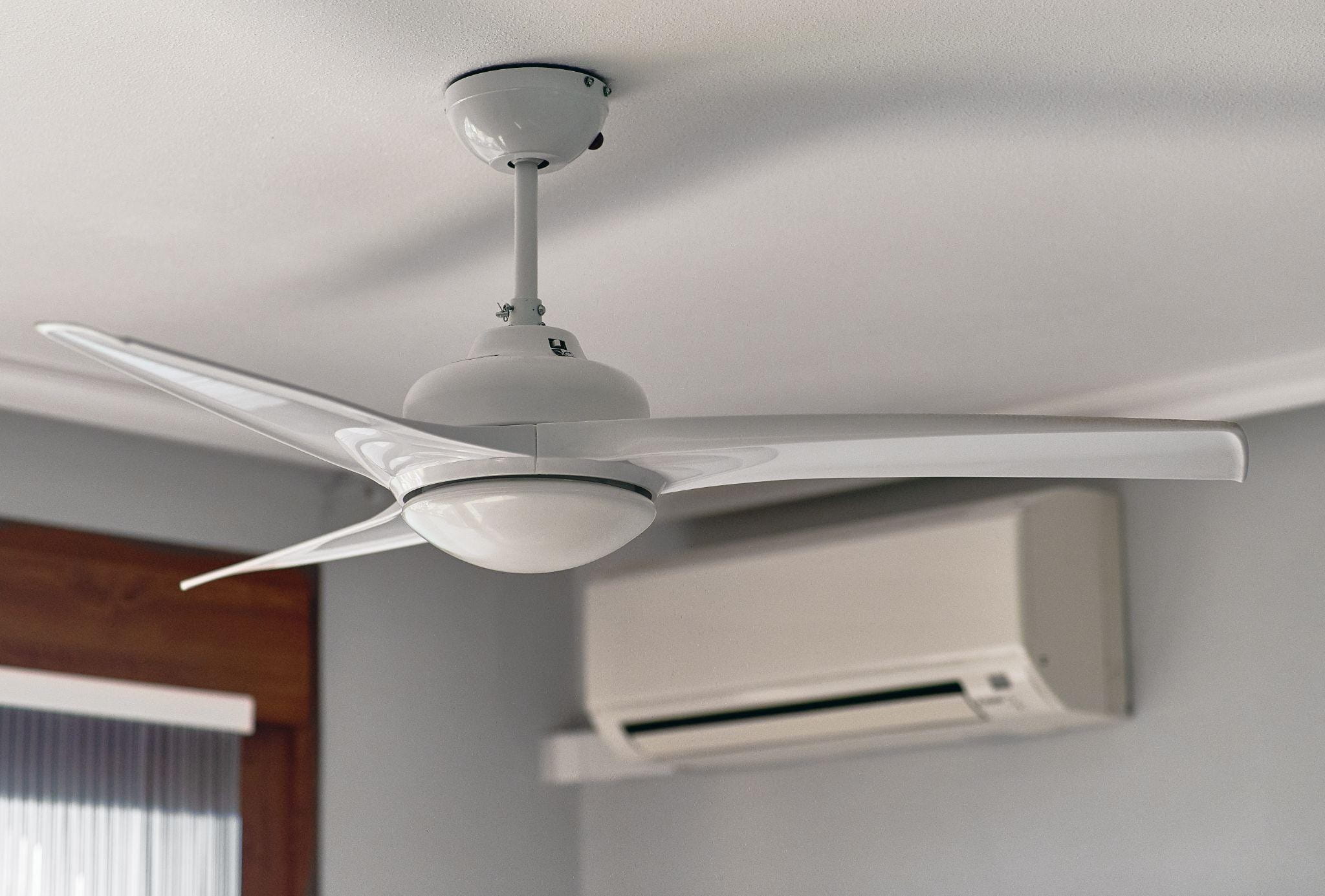
When choosing the right cooling solution for your home, there is more to consider than just comfort. Climate control can also impact your home’s energy bills, environmental footprint, and the way you use your living spaces.
Ceiling fans and air conditioners each have distinct advantages and limitations, and understanding how they perform in different climates, room sizes, and usage scenarios is key to making the right choice. In this guide, we break down the pros and cons of choosing a ceiling fan and air conditioner, compare their performance, energy costs, and environmental impact, and share tips for maximising efficiency
Pros and Cons of Ceiling Fans
Energy-efficient ceiling fans are a tried and true, practical way to improve airflow and comfort in your home.
One of their biggest advantages is their lower electricity consumption compared to air conditioning systems. By circulating air effectively, ceiling fans help rooms feel cooler without significantly increasing power bills, making them a cost-effective option for everyday use.
They are particularly well-suited to older homes with small and medium-sized rooms such as bedrooms, living areas, and covered outdoor spaces, where consistent air movement can noticeably improve comfort. Many upgraded ceiling fans for homes also feature “winter/summer” settings, which will rotate anticlockwise at higher speeds in summer to create a cooling breeze and clockwise at low speeds in winter to circulate warm air downwards, making them useful all year long.
However, ceiling fans do have their limitations.
In periods of extreme heat, especially during peak summer temperatures or heat waves, a fan alone may not sufficiently cool a space, as it does not lower the actual air temperature. Instead, it creates a wind-chill effect that makes occupants feel cooler.
In very large or poorly insulated rooms, performance can also be reduced. For this reason, ceiling fans are often most effective when used in combination with air conditioning, helping to distribute cooled air more efficiently while still keeping energy costs under control.
Pros and Cons of Air Conditioners
Home air conditioners are the go-to solution for powerful and consistent temperature control, especially during Australia’s hottest months.
One of the biggest strengths of air conditioning is its superior cooling power: air conditioning units can quickly and effectively lower indoor temperatures, creating a comfortable environment even in extreme heat that ceiling fans alone cannot manage. This makes them ideal for big spaces where reliable climate control is essential, like living rooms, open-plan settings, and high-traffic areas.
However, this performance comes at a cost—literally.
Air conditioners generally consume far more energy than ceiling fans, which can lead to higher electricity bills if used frequently or installed inefficiently. The type of unit you choose also affects both performance and running costs.
Split system air conditioners are popular for their efficiency, quiet operation, and flexible installation, while window units and portable models offer more budget-friendly options with varying levels of power and mobility. Understanding these trade-offs will help property owners choose the right system for their home.
Side-by-Side Comparison: Ceiling Fan vs. Air Conditioner
There are many options available for cooling a living space, whether via air conditioning or ceiling fans. Choosing the right cooling solution comes down to comparing multiple factors, such as performance, room size, energy costs, and more.
Side-by-Side Comparison: Ceiling Fan vs. Air Conditioner | ||
Feature | Ceiling Fan | Air Conditioner |
Comfort & Cooling | Creates a cooling breeze by circulating air via a wind-chill effect (Does not lower actual air temperature.) | Actively lowers indoor temperature for strong, consistent cooling. (Ideal for extreme heat.) |
Monthly Energy Costs | Very low running costs, minimal electricity use. Suitable for everyday operation. | Higher running costs from greater energy consumption, especially during frequent use. |
Environmental Impact | Lower environmental footprint due to reduced electricity demand. | Higher environmental impact compared to fans, depending on usage and system efficiency. |
Best Room Size | Small to medium rooms such as bedrooms and living areas. | Large rooms, open-plan areas, and high-traffic spaces. |
Performance in Extreme Heat | Limited during heatwaves. Most effective when paired with air conditioning. | Highly effective even during peak summer temperatures. |
Installation Options | Fixed ceiling installation with seasonal settings available. | Split system, window, or portable units are available with varying installation requirements. |
Ideal For Homeowners Who Want… | Energy efficiency and lower ongoing costs. | Powerful cooling and full climate control. |
Tips to Maximise Comfort and Efficiency
Proper setup and smart usage can make a huge difference in comfort, energy efficiency, and monthly costs. Here are some ways you can be sure to get the most out of your cooling systems.
Fan Placement
Where you position your ceiling fan can dramatically impact airflow. Ideally, fans should be installed in the centre of the room, with blades rotating clockwise in winter to push warm air down and anticlockwise in summer to create a cooling breeze.
For larger or irregularly shaped rooms, consider multiple fans or strategically placed units to circulate air evenly. Correct placement ensures maximum comfort while keeping energy use low.
Using Air Conditioning with a Fan
What a great pair! Running a ceiling fan alongside your air conditioner is one of the easiest ways to save on energy costs without sacrificing comfort.
Fans help distribute cooled air throughout the room, allowing you to set the AC at a slightly higher temperature. This combination reduces the workload on your air conditioner, extends its lifespan, and keeps electricity bills in check, all while maintaining a consistent indoor climate.
Smart Thermostats and Timers
Modern AC systems often include home automation features like smart thermostats and programmable timers, which can automatically adjust temperatures based on your schedule. Pairing these features with ceiling fans enhances efficiency by preventing overcooling when rooms are unoccupied.
Smart home upgrades can also track energy use, helping you optimise settings to save money and reduce environmental impact.
Choosing the Right Cooling Solution for Your Home
Selecting the best cooling option depends on your space, local climate, and budget.
Ceiling fans are an energy-efficient, low-cost way to improve airflow and comfort, making them ideal for small to medium rooms or moderate heat. Air conditioners, on the other hand, provide powerful, consistent cooling that is essential during extreme heat or in larger, high-traffic spaces.
For many homes, the most effective solution is a combination of both: ceiling fans to circulate air and reduce strain on your air conditioner, and AC units to deliver strong cooling when needed most.
By pairing these systems with smart thermostats, timers, and thoughtful fan placement, you can maximise comfort while keeping energy bills and environmental impact under control.
Ready to make your home more comfortable year-round but are unsure which option is right for you? Call us for expert advice, installation, and solutions tailored to your space, or get a quote today!
Whether you need a ceiling fan, an air conditioner, or both, Approved Electrix is here to help you stay cool efficiently and affordably.
Read more: Winter Patio Heating Tips for Melbourne Homes
FAQs
Here are some frequently asked questions about using AC and ceiling fans in your home.
Is a ceiling fan enough in summer?
Ceiling fans can provide comfort in mild to moderately hot weather by circulating air and creating a cooling breeze. However, they do not lower the actual air temperature, so during extreme heat or heatwaves, a fan alone may not be sufficient.
For larger rooms or very hot climates, pairing a fan with an air conditioner can provide the most reliable comfort.
How much electricity does a ceiling fan use vs AC?
Ceiling fans are highly energy-efficient and use a fraction of the electricity that an air conditioner consumes. On average, a standard ceiling fan uses around 15–75 watts per hour, depending on speed, while air conditioners can consume anywhere from 600 watts to 3,500 watts per hour, depending on the type and size of the unit.
This makes a ceiling fan an excellent option for reducing energy costs during everyday use.
Can you use a fan and AC together?
Yes! Fans help circulate cooled air throughout the room, allowing you to set the AC at a slightly higher temperature. This combination reduces energy consumption, lowers electricity bills, and helps your AC operate more efficiently while maintaining consistent comfort.
