
When working with mains cables in Victoria and completing electrical renovations, electricians often need to book a truck appointment with the power distributor to carry out safe and compliant work. Whether you’re upgrading consumer mains, relocating a point of attachment, or replacing service cables, coordination with the distributor is an essential part of the process.
From our past experiences at Approved Electrix, we’ve seen how the process works in practice — and the common pitfalls that can catch electricians out under the Victorian Service and Installation Rules (SIRs).
This blog provides an overview of what’s involved, including the July 2025 updates to the SIRs, but please note: every job is different, and it’s crucial to seek clarification directly from the power distributor before proceeding.
Step 1: All Mains Upgrades Require a Truck Appointment
All upgrades of consumer mains from the meter to the street by residential electricians will require a truck appointment, whether the mains are underground or overhead. This is because the distributor’s service cable and point of supply are always involved.
Examples include:
- Overhead mains upgrades – replacing or relocating service cables, riser brackets, or the point of attachment.
- Underground mains upgrades – replacing consumer mains through a new trench or conduit from the meter to the pit or pillar.
- Raising or relocating service cables to comply with clearance requirements.
⚠️ Common trip-up: Assuming underground consumer mains upgrades don’t need a truck — they do. Any work between the meter and the street supply point will involve the distributor.
Step 2: Submitting the Request
Booking a truck appointment typically involves submitting a request through the distributor’s online portal (e.g. AusNet, Powercor, CitiPower, Jemena, or United Energy). You’ll usually need:
- The address of the property.
- The scope of works (upgrade, relocation, etc.).
- The required date (allowing for distributor lead times).
- A copy of the Certificate of Electrical Safety (COES) once the work is complete.
- The NMI (National Metering Identifier) number – most distributors now require this when lodging the application. The NMI can be found on the account holder’s energy bill.
💰 What’s the cost of a truck appointment?
For reference, Jemena currently charges around $784 (ex. GST) for a single truck appointment, and $1,568.64 (ex. GST) for two appointments. Other Victorian distribution companies have very similar pricing structures, so you can expect costs in the same ballpark.
⏳ What timeline can you expect for your truck appointment?
Distributors will usually be able to book the work with the electrician within around 4 weeks of the request being lodged. This can vary depending on workload, weather events, and demand in your area.
Pro tip: Always build in some flexibility with scheduling. Distributor availability can be limited, especially during high-demand periods.
Step 3: Preparing for your Truck Appointment
Before the distributor arrives, electricians must ensure the installation complies with the Victorian Service and Installation Rules (SIRs). Here are some common areas where mistakes happen:
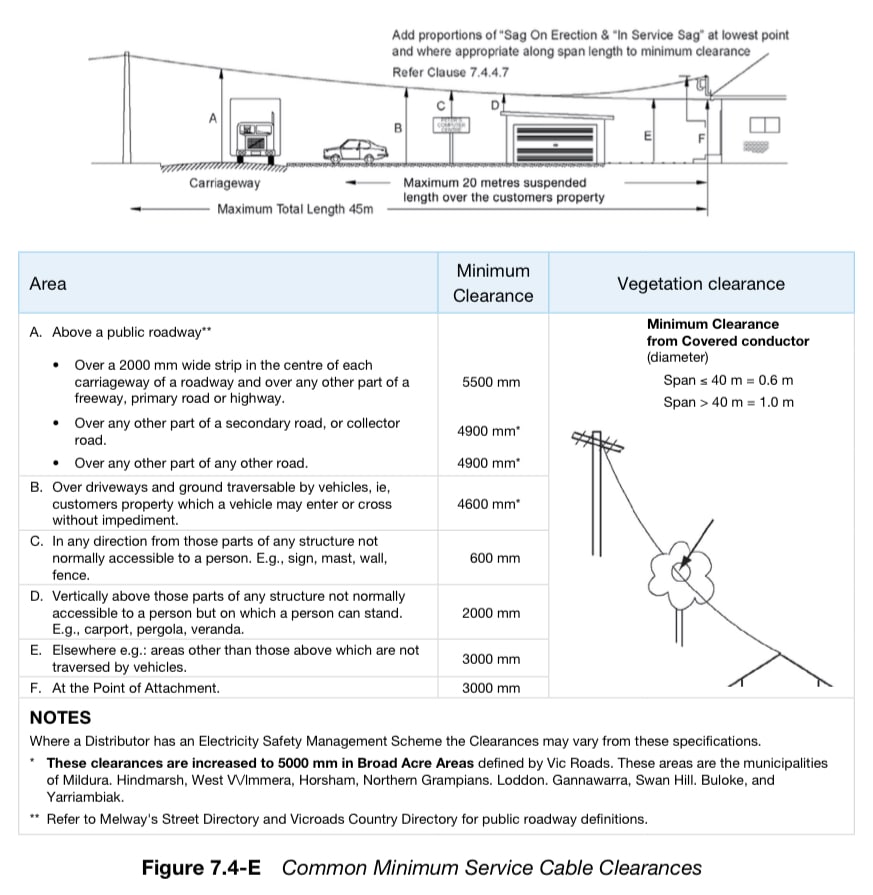
a) Clearance Heights Over Driveways and Roads
The SIRs specify minimum clearance heights for overhead cables. For example, a minimum of 4.6m over driveways is required (many electricians incorrectly assume 5.6m).
Measuring with a proper telescopic measuring pole is essential — guesswork can get you into trouble.
b) Riser Brackets and Points of Attachment
Riser brackets are critical for supporting overhead service cables at the correct height and alignment. There are two common types used in Victoria:
- Fascia-mounted riser brackets – fixed directly to the fascia board.
- Through-tile riser brackets – designed to penetrate the roof tiles and provide extra stability when fascia mounting isn’t practical.
These brackets now generally come in two height options: 600mm and 900mm.
⚠️ Important Updates (July 2025 SIRs):
- 1200mm riser brackets are no longer permitted in Victoria.
- Coach bolts must always be used when fixing riser brackets — normal screws are not compliant.
- Stay wires must always be installed, and they must run in the same direction that the service cable is aligned with, ensuring the bracket can withstand the pull of the cable.
📑 Direct from the SIRs:
“Riser brackets shall be of a type approved by the Distributor, mounted in accordance with the manufacturer’s instructions, and installed to provide adequate mechanical strength and clearances. Standard heights available are 600 mm and 900 mm. Fascia-mounted and through-tile types are acceptable, provided they are installed correctly and in compliance with Distributor requirements.”
⚠️ Common trip-up: Installing the wrong height or type of riser bracket, failing to use coach bolts, or neglecting stay wires.
c) Earthing and Bonding
- Where service cables are altered, check that the main earthing system complies with AS/NZS 3000.
- Distributors will not proceed if the main earthing or MEN connection is non-compliant.
d) Obstructions and Safety Hazards
- Overhead service cables cannot pass too close to balconies, verandas, or accessible roofs.
- This is a common trip-up in older properties where renovations have altered roof lines.
e) Mains Cable Protection in Walls
⚡ Pro Tip — Cable Protection Rule:
- If the cable is installed in a wall that contains insulation and the clearance from the cable to the wall surface is 50mm or less, then the mains cable must be run in steel conduit or anaconda and correctly earthed.
- This protects against damage from nails, screws, or other fixings that could penetrate the wall.
- Exception: If the cable is installed in the cavity of an external brick veneer wall, additional mechanical protection is not required — provided the cable is properly supported in the cavity.
⚠️ Common trip-up: Running mains cables directly in insulated walls without mechanical protection or proper earthing.
f) Meter Box Location and Clearances
⚡ Pro Tip — Meter Box Requirements:
- Gas meter separation: Always check the distance between the gas meter and the electrical meter box — it must be no less than 500mm.
- Front clearance: Ensure there is at least 1 metre of clear space in front of the meter box to any obstruction (walls, fences, air-con units, hot water systems, etc.). The box must be easily and safely accessible at all times.
- Weather protection: If the meter is installed externally without an enclosure but under cover (e.g. a veranda), the cover must comply with the SIR requirement for protection from rain — meaning it must provide sufficient shielding within a specified angle of cover (📐 typically measured from vertical, as detailed in the SIR diagrams).
⚠️ Common trip-up: Installing a new meter box too close to a gas meter, failing to maintain the full 1m clearance in front, or assuming any veranda roof counts as protection — when in fact the SIRs require compliance with the angle of rain protection rule (see SIR figures for reference).
Step 4: What to Do on the Day of your Truck Appointment
When the distributor’s crew arrives, they’ll expect the site to be safe and ready for the work. That means:
- Access is clear for the truck.
- The new POA, riser bracket, or mains are installed to spec.
- The electrician is present to liaise with the distributor crew.
Any non-compliance with the SIRs will mean delays — or, in some cases, refusal to connect.
Step 5: After your Truck Appointment
Once the overhead connection is complete, you’ll need to:
- Finalise your electrical installation work.
- Test and issue the Certificate of Electrical Safety (COES).
- Submit any required paperwork to the distributor for records.
Special Case: Truck Appointments Under a Defect Notice
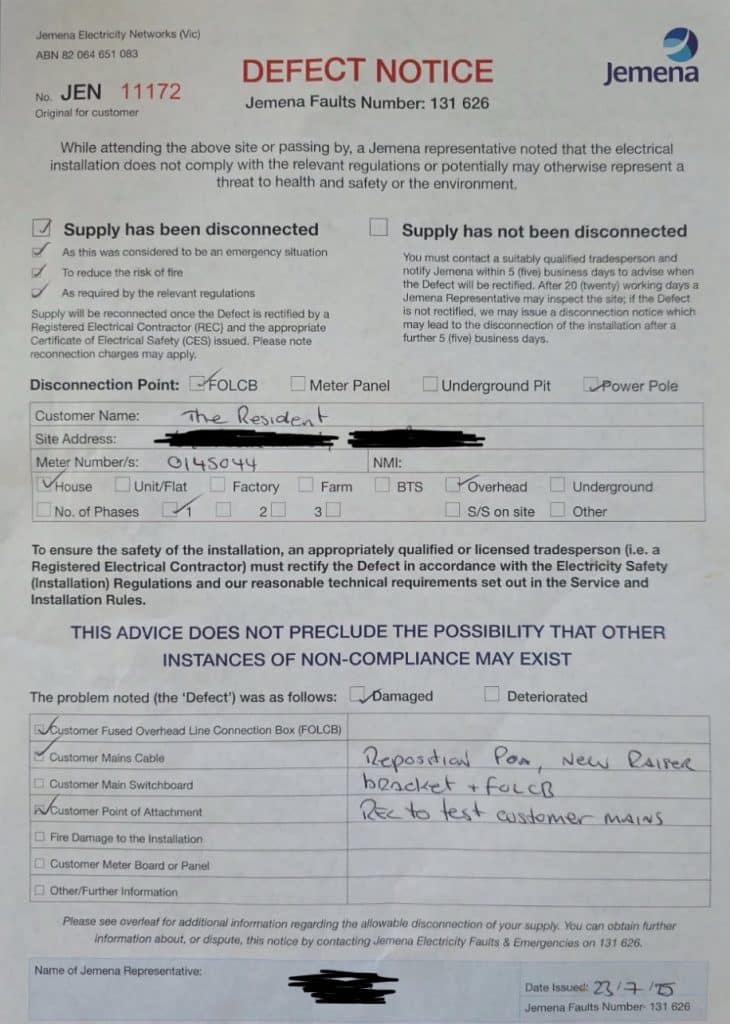
Truck appointments for defect rectification work operate differently to standard bookings. For truck appointments under an electrical defect notice, you do not need to book through the distributor’s portal.
Instead, your REC (Registered Electrical Contractor) calls the power company directly to explain they are attending the site today to fix the defect and require a disconnect.
The distributor will usually send a truck to disconnect and make safe within around 2 hours (subject to workload and weather events).
Once the repairs are completed, the electrician calls the distributor back and they will usually send a truck to reconnect again within around 2 hours.
Certificates Under a Defect Notice
If you’re only repairing or replacing one single item (e.g. replacing a faulty mains box), you only need to issue a non-prescribed Certificate of Electrical Safety (COES) — no inspection is required.
As soon as you’re carrying out multiple repairs or replacements, you must issue a prescribed COES and have the work signed off by an independent inspector.
⚠️ Common trip-up: Treating defect rectification like standard works and booking through the portal, or issuing the wrong COES type (non-prescribed vs prescribed).
Important SIR Update: July 2025 Changes to Service Cable Routes
One of the biggest recent changes electricians need to be aware of is the updated wording around Service Cable Routes in the July 2025 edition of the SIRs. These updates affect both existing installations and new/upgrade works.
📑 Direct from the July 2025 SIRs (Clause 7.4.4.8):
7.4.4.8.1 Existing Installations
- Applies to minimal renewal works (fascia replacement, cotton-clad mains renewal, switchboard replacement).
- Service cable routes crossing adjacent properties may remain if there’s no risk of obstruction.
- Conditions if the existing route is retained:
a. Point of supply, attachments, and metering must be clearly accessible.
b. Minimise or avoid property crossings where possible.
c. Relocate the point of attachment if practical to improve the route.
d. Maintain minimum service cable heights as per the Electricity Safety (Management) Regulations.
e. Service cables cannot cross swimming pools or spas — they must be relocated.
7.4.4.8.2 Upgraded & New Installations
- Applies to new installations and capacity upgrades (e.g. EV chargers, multiphase supplies).
- A service cable over an adjacent property is only permitted if:
- There is no risk of obstruction, and
- It does not encroach over more than 25% of the front boundary length or 2 metres of the side boundary.
- Service cables should avoid crossing roads, driveways, vehicle areas, roofs, or structures wherever possible.
- Service cables must not cross swimming pools or spas.
⚠️ Why this matters
Many electricians will get caught out if they continue working from memory of the older SIRs wording. These changes impact not just new builds but also common upgrades like consumer mains for EV chargers, induction cooktops, and air conditioning.
⚡Quick Checklist Before Booking a Truck Appointment
Use this checklist to avoid the most common pitfalls that delay or fail truck appointments:
- All mains upgrades from the meter to the street (overhead or underground) require a truck appointment.
- NMI number ready (from the customer’s energy bill).
- COES prepared for submission after the works.
- Clearances measured (e.g. 4.6m minimum over driveways).
- Riser bracket compliant – only 600mm or 900mm (1200mm not permitted).
- Coach bolts used to secure riser brackets.
- Stay wires installed in the same direction as the service cable pull.
- Mains cable protected (steel conduit or anaconda + earthing) if clearance to wall surface ≤ 50mm and wall contains insulation.
- Exception noted – brick veneer cavities can be used without additional protection.
- Gas meter separation checked – minimum 500mm from electrical meter box.
- Meter box clearances confirmed – 1m minimum front clearance, no obstructions.
- Weather protection – if installed under cover (e.g. veranda), ensure compliance with the SIR angle of rain cover requirement.
- Service cable route rules (July 2025 SIR update):
- Existing installs – crossings may remain if unobstructed.
- New/upgraded installs – no more than 25% front boundary / 2m side boundary encroachment.
- No crossings over pools/spas.
- Defect Notice Jobs: Don’t book online — call the distributor directly. Correct COES issued (non-prescribed for single repairs, prescribed + inspector for multiple works).
- Timing: Allow around 4 weeks for distributor booking (longer during high-demand or storm seasons).
Final Thoughts
Booking and coordinating a truck appointment with Victoria’s power distributors is part of the job for many electricians — but it’s also an area where compliance mistakes can cost time, money, and customer trust.
From our experience, the most common pitfalls are clearance miscalculations, incorrectly installed riser brackets, not using coach bolts or stay wires, missing NMI details, underestimating truck fees, overlooking mains protection and meter box rules, and failing to follow the July 2025 SIR updates. The Victorian SIRs are strict for a reason — and the distributor crews enforce them firmly.
Our team at Approved Electrix has had extensive experience booking truck appointments with all Victorian distributors. If you’d like our expert assistance with your next mains upgrades or other works, simply contact us at 03 8370 5737 or request a quote via our website.
⚠️ Important Note: This blog is based on past experiences. Rules, processes, and distributor requirements can change. Always seek clarification from the power distributor before booking or carrying out work. The SIRs can easily be found at https://www.victoriansir.com.au/.
